
Rule 54 of the South African Legal Practice Council Rules is the accounting rulebook for every firm that holds client money. It sits on top of sections 84 to 91 of the Legal Practice Act 28 of 2014 and turns their broad duties ("keep proper accounting records") into specific, auditable obligations. This guide walks through what Rule 54 actually asks of a firm, in the order a bookkeeper meets it during a normal month, with the rule numbers so you can check each point yourself.
Rule numbers below follow the LPC Rules as published in 2018. The LPC has since amended parts of Rule 54 (including 54.9.2.1, 54.12, 54.15.3, 54.34 and, in December 2023, 54.14.16). The LPC lists each amendment separately on its rules and regulations page rather than publishing a consolidated version, so check that page before relying on exact wording.
This article is general information, not legal or accounting advice. Your auditor and the LPC are the authorities on how the rules apply to your firm.
Who Rule 54 applies to
Part XII of the rules (Rules 54 to 56) applies to "legal practitioners conducting a trust account practice" (Rule 54.1). In practice that means:
- attorneys practising for their own account, alone, in partnership or as directors of an incorporated practice, who must hold a Fidelity Fund certificate under section 84(1) of the Act;
- advocates practising with a Fidelity Fund certificate under section 34(2)(b), who may take instructions directly from the public and hold trust money.
Section 86(1) says every practitioner referred to in section 84(1) must operate a trust account. And Rule 54.19 makes every partner and every director personally responsible for the firm's trust accounting. "The bookkeeper handles that" is not a defence.
The records you must keep (Rules 54.6 to 54.9)
What goes in the books
Rule 54.6 requires accounting records, in an official language, that record both business and trust transactions and are good enough to produce financial statements under IFRS or IFRS for SMEs (Rule 54.7). At minimum they must show:
- all assets and liabilities (54.6.1);
- day-to-day entries of all money received and paid on the firm's own account (54.6.2);
- all money received, held and paid for any person (54.6.3.1);
- all money invested under section 86(3) or 86(4) (54.6.3.2);
- trust interest paid over or credited (54.6.3.3 and 54.6.3.4).
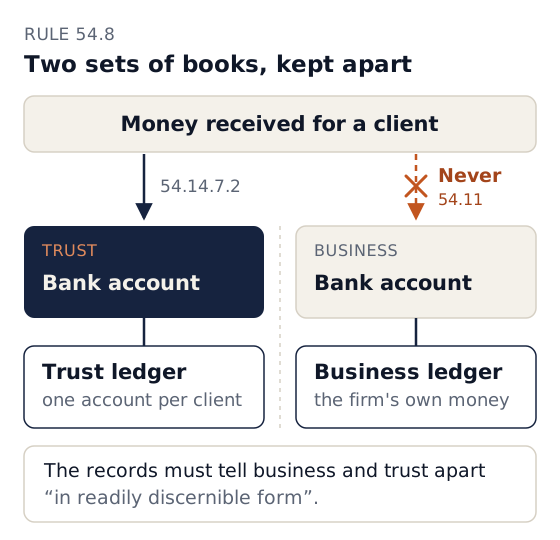
Rule 54.8 adds a principle that shapes everything else: the records must distinguish "in readily discernible form" between business and trust transactions. A single ledger with a "trust" tag on some lines is weak evidence of that. Separate trust and business ledgers, each with its own bank account, is the norm.
How long to keep them, and where
Rule 54.9.1 requires the firm to keep its accounting records and all files and documents relating to client matters for at least seven years from the last entry in each record or file. Rule 54.9.2 says where: the main office, a branch office, or for electronic records, where they are ordinarily hosted, provided they are "reasonably secured" and "immediately accessible" to authorised people at the firm and to the Council.
If your software vendor holds your records, that last requirement is yours to enforce. Ask how you would get a full, readable export if the vendor disappeared tomorrow.
Rule 54.14.4.2 is explicit that electronic records must stay retrievable in readable and printable form, "including by converting the records from legacy to later systems". Old software that only your retired bookkeeper can open is a Rule 54 problem, not just an IT one. (See our guide to switching practice management software without losing data.)
- How long
- At least seven years from the last entry in each record or file 54.9.1
- What
- The accounting records and all files and documents relating to client matters 54.9.1
- Where
- The main office, a branch office, or where electronic records are ordinarily hosted 54.9.2
- On what terms
- Reasonably secured, and immediately accessible to authorised people at the firm and to the Council 54.9.2
- In what form
- Retrievable in readable and printable form, including after moving from legacy to later systems 54.14.4.2
Backups and electronic banking
- Computerised records need monthly backups kept in a safe, fireproof place remote from the firm (54.14.3).
- Where you pay from trust by electronic banking, you must keep a proper audit trail including verification of the payee's bank account details (54.14.5). Rule 54.13 separately requires you to verify a client's bank details before paying them, and to re-verify any change. Business email compromise frauds, where a fraudster "updates" a client's banking details by email, are exactly what this rule targets.
Monthly: write up, balance, list
Write up by the end of the following month (Rule 54.10)
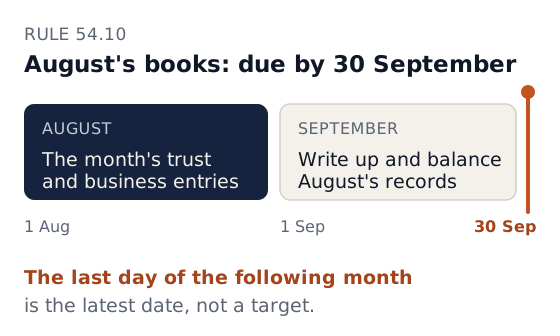
A firm must update and balance its accounting records monthly. It is deemed to comply if, among other things, the records for a month are written up by the last day of the following month. August's books must be written up by 30 September. That is the latest date, not a target.
Extract the list of trust creditors (Rule 54.15)
Every month the firm must extract a legible list of every person for whom money is held, with the balance for each, identified by name. The list is totalled and compared with the total of the trust bank account, trust investment accounts, trust cash and other trust assets (54.15.1). Each balance must also be noted in the ledger account it came from (54.15.2), and the list forms part of the accounting records (54.15.3).
This monthly comparison is the heart of trust accounting. We cover it step by step in our trust account reconciliation checklist.
The two numbers that must never go wrong (Rules 54.14.8 and 54.14.9)
| Rule | What must be true | If it is not true |
|---|---|---|
| 54.14.8 | Trust bank + trust investments + trust cash is not less than the total of trust creditor credit balances | Report to the Council immediately, in writing, with the reason and proof of rectification (54.14.10) |
| 54.14.9 | No trust creditor's account is in debit | Report to the Council immediately, in writing, with the reason and proof of rectification (54.14.11) |
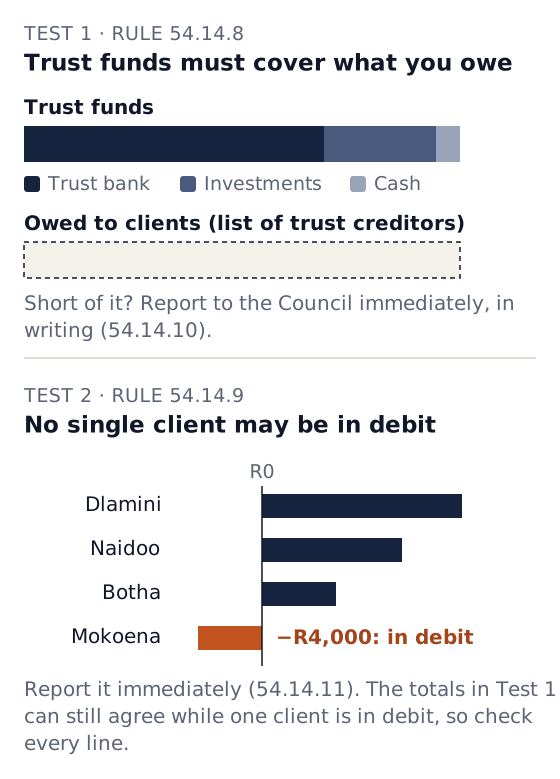
A trust creditor in debit means you have paid out more for a client than you held for that client, so some other client's money funded it. It often happens innocently: a cheque that bounced after you paid out against it, or a transfer posted to the wrong matter. The rule does not care why. Good software should refuse, or at least loudly warn, before a payment takes a client ledger below zero.
Receiving money
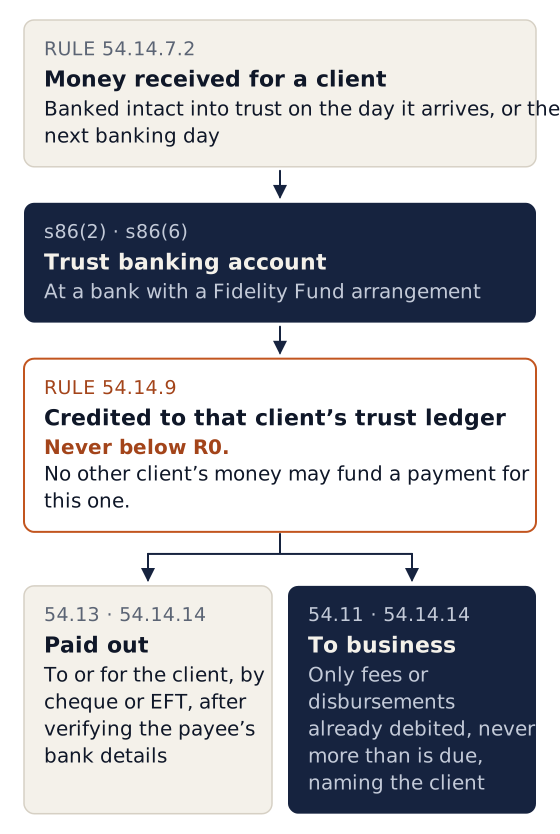
- Deposit intact and promptly. Money received for any person goes into the trust banking account on the day of receipt or the next banking day it could reasonably be banked (54.14.7.2). "Intact" means no netting off fees before banking.
- Only at an approved bank. Trust money must be banked with a bank that has an arrangement with the Legal Practitioners' Fidelity Fund under section 63(1)(g), unless the Council consents otherwise (54.14.7.2; section 86(2) and 86(6) of the Act).
- Deposits on account are trust money. Money paid in advance for fees or disbursements, including counsel's fees, goes into trust (54.14.13). Section 84(3) of the Act says the same.
- Never into business. Trust money may in no circumstances be deposited into a business account (54.11).
Paying money out
Who may be paid from trust (Rule 54.14.14)
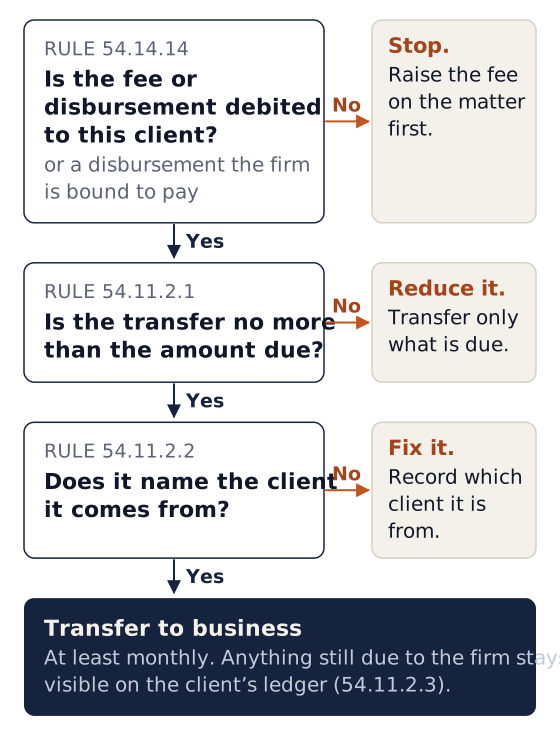
Withdrawals from trust may only be made to or for a trust creditor, or as transfers to the firm's business account for money due to the firm. A transfer for fees or disbursements is allowed only if:
- the disbursement has actually been made and debited; or
- the firm is contractually obliged to pay the disbursement; or
- the fees and disbursements have been correctly debited in the accounting records.
In plain terms: raise the fee note on the matter first, then transfer. Transferring a round R10,000 "on account of fees" with no fee debited against that client is the classic audit finding.
Transfers from trust to business (Rule 54.11)
Business money found in trust must go to business "without undue delay". A firm is deemed to comply if it transfers at least monthly and each transfer:
- is identifiable with, and does not exceed, the amount due to the firm (54.11.2.1);
- identifies the trust creditor it comes from (54.11.2.2);
- leaves any remaining amount due to the firm identifiable in the trust ledger (54.11.2.3).
Rule 54.14.12 then requires a system that stops these requirements being infringed. That is an internal-controls obligation, and one of the clearest places where software earns its keep.
How payments may be made (Rule 54.14.15)
Trust payments only by cheque made payable to a named payee, or by electronic transfer. No withdrawals by cellphone or telephone transacting.
Interest on trust money (Rule 54.14.16, as amended)
Interest on the general trust account (section 86(2)) and on section 86(3) investments belongs to the Fidelity Fund. Interest on a section 86(4) investment belongs to the client, less 5% that goes to the Fund (section 86(5)).
The December 2023 amendment (Government Gazette 49833, Notice 2234) moved all three payments onto the Automated Monthly Transfer System: the practice's bank pays the Fund's share within five working days of the month following the month in which the interest vested.
You still need to record it correctly. Our section 86 guide covers the accounting entries.
Accounting to clients (Rules 54.12 and 54.13)
Within a reasonable time after a mandate ends, the firm must give the client a written account showing:
- all amounts received, explained;
- all disbursements and payments made;
- all fees and charges, with a statement where a fee was agreed and the agreed amount;
- what is owed to or by the client.
Keep a copy with the accounting records (Rule 54.12 sets the minimum retention for these accounts; it was amended in 2020, so check the current text). Then pay the client what is due within a reasonable time, after verifying their banking details (54.13).
Internal controls (Rule 54.14.7.1)
Rule 54.14.7.1 is short but broad. The firm must implement internal controls that are appropriately designed for identified risks, implemented as designed, operating effectively throughout the period, and monitored regularly by designated people with authority. Your auditor will test this. A workable minimum for a small firm:
- Two people involved in every trust payment: one captures, one releases (bank dual authorisation).
- Only named people can change a client's banking details, and every change is verified by phone on a number already on file.
- The monthly reconciliation is prepared by one person and reviewed and signed by a partner or director.
- Access to the accounting system is per person, not a shared login, so the audit trail means something.
- A reviewed month is locked so it cannot be edited quietly afterwards.
The annual audit and the Fidelity Fund certificate
Every trust account practice must appoint an auditor at least once a calendar year (54.20). The auditor's report must reach the Council within six months of the firm's annual closing of its accounting records (54.24.1). A new firm must submit a report covering its first four months within six months of starting practice (54.21).
- Every calendar yearAppoint an auditor. At least once a year (54.20).
- Annual closingClose the year's accounting records. The reporting clock starts here.
- Within six monthsThe auditor's report reaches the Council (54.24.1). A new firm reports on its first four months within six months of starting practice (54.21).
- Fidelity Fund certificateUnqualified and on time. Without that report there is no certificate (54.29), and without a certificate the firm may not receive or hold trust money (s84(2)).
The auditor must report directly to the Council without delay if trust creditor balances exceed trust funds, if material queries go unanswered, or if access to records is refused (54.24.2).
To be issued a Fidelity Fund certificate, a practitioner needs an unqualified audit report for every firm they were a partner, director or sole practitioner of during the period, delivered on time (54.29). No certificate means no trust money: section 84(2) of the Act prohibits receiving or holding funds without one. See our Fidelity Fund certificate and trust audit checklist.
Rule 54 at a glance
| Frequency | Obligation | Rule |
|---|---|---|
| Every receipt | Bank intact into trust by the next banking day | 54.14.7.2 |
| Every payment | Only to or for a trust creditor, or a fee/disbursement transfer that is properly debited | 54.14.14 |
| Every payment | Verify payee bank details; keep an audit trail | 54.13, 54.14.5 |
| At least monthly | Transfer business money out of trust, identifiable per client | 54.11 |
| Monthly | Write up and balance by end of following month | 54.10 |
| Monthly | Extract, total and compare the list of trust creditors | 54.15 |
| Monthly | Back up computerised records off-site | 54.14.3 |
| Immediately | Report a trust deficit or a trust creditor in debit | 54.14.10, 54.14.11 |
| End of mandate | Written account to client; pay what is due | 54.12, 54.13 |
| Annually | Auditor's report within six months of year-end | 54.20, 54.24 |
| Seven years | Retain records and files | 54.9.1 |
Where software helps and where it cannot
Software cannot make a firm meet Rule 54. The partners and directors are responsible (54.19), and the auditor decides whether the records hold up. What good software can do is make the right behaviour the easy behaviour: keep trust and business in separate ledgers, stop a client ledger going into debit, tie every trust-to-business transfer to a fee on a named matter, produce the monthly list of trust creditors in one click, and lock a month once it has been reconciled and signed off.
Caseo is practice management software built around LPC Rule 54. Trust and business are kept in separate ledgers against each matter. Caseo refuses any trust payment, transfer or reversal that would leave a matter in debit on any day from its date onward, refuses a fee transfer larger than the fees and disbursements the matter owes, and only allows trust entries to be reversed, never deleted.
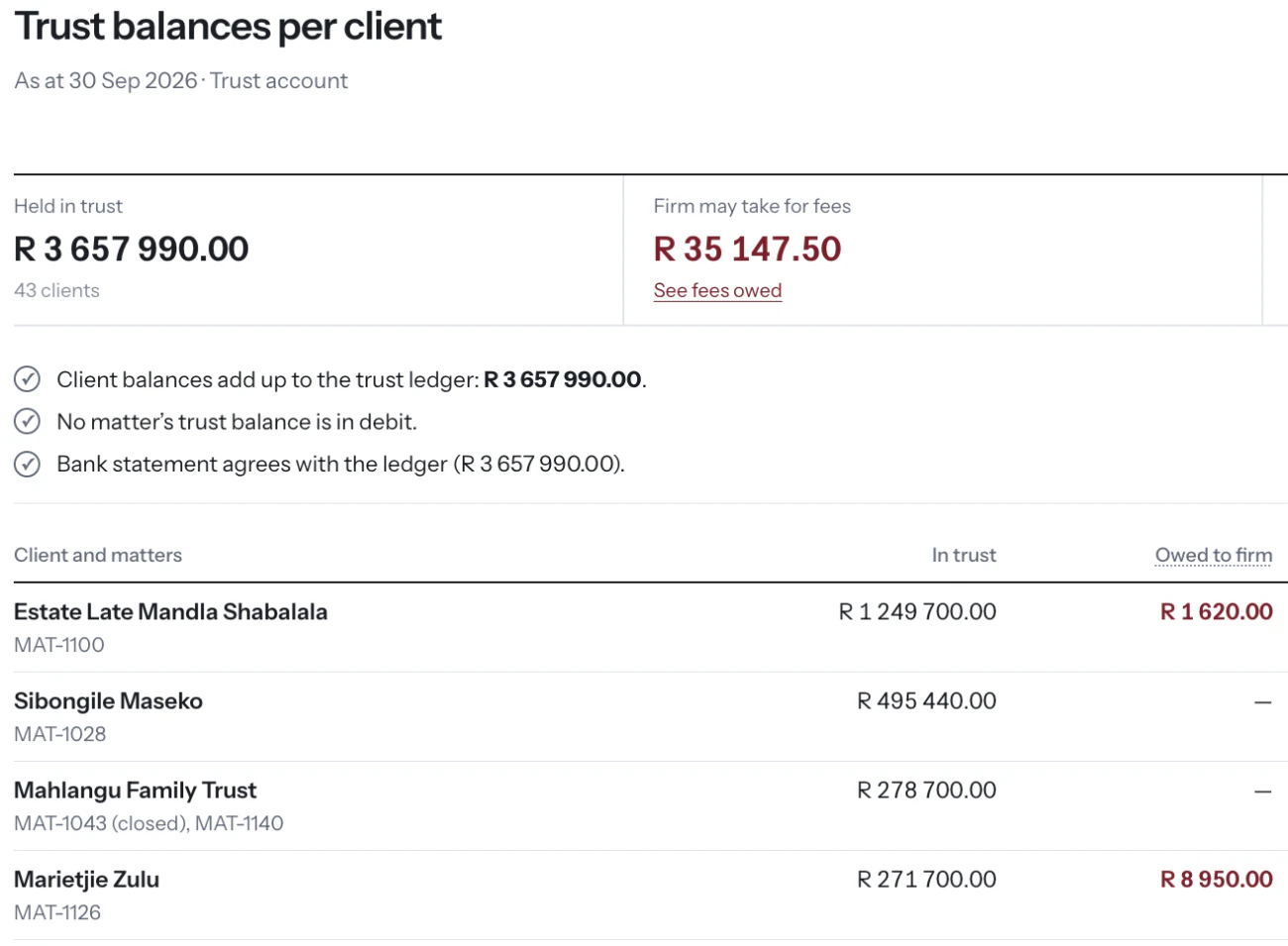
The trust balances per client report checks itself against the trust ledger, and the monthly bank reconciliation is matched line by line and locked once signed off.
 1
2
3
4
1
2
3
4
- Held in trust: the total the firm holds for clients on the chosen date.
- The report checks itself against the trust ledger.
- It confirms no matter is in debit, the Rule 54.14.9 test.
- Each client by name, with the balance held for them.
Ask us to call you and we will show it on sample data or your own files. Read more about how trust accounting works in Caseo.