
Section 86 of the Legal Practice Act 28 of 2014 is seven short subsections that decide where client money may sit, who may invest it, and who gets the interest. It replaced section 78 of the old Attorneys Act, which is why older bookkeepers still say "78(2A)" when they mean an 86(4) investment. The detail on how to account for it lives in LPC Rule 54.
General information, not legal or accounting advice.
The section in one table
| 86(2) trust banking account | 86(3) trust investment | 86(4) client investment | |
|---|---|---|---|
| Who decides | Mandatory for every trust account practice | The firm, "of its own accord" | The client, on whose instructions it is opened |
| What goes in | All money held on behalf of any person, deposited as soon as possible | Trust money "not immediately required for any particular purpose" | Money of a specific person, invested for that person |
| Interest belongs to | Legal Practitioners' Fidelity Fund | Legal Practitioners' Fidelity Fund | The client, less 5% to the Fund |
| Legal basis for interest | s86(5)(a) | s86(5)(a) | s86(5)(b) |
| Where | A bank with an arrangement with the Fund under s63(1)(g) | Same | Same |
Subsections (6) and (7) close the loop: you may not deposit or invest trust money at a bank that has no arrangement with the Fund without the Fund's prior written consent, and you must comply with the terms of that arrangement.
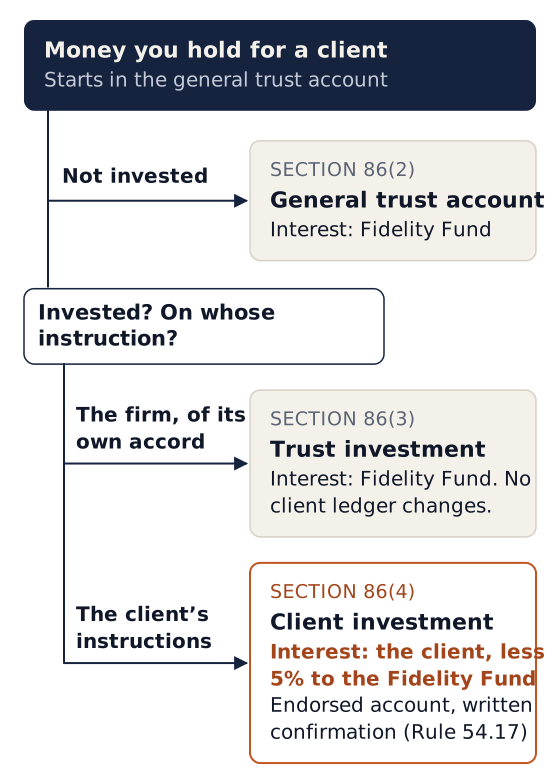
Section 86(1) and (2): the trust banking account
Every practitioner who must hold a Fidelity Fund certificate under section 84(1) must operate a trust account (s86(1)). The account must be at a bank with which the Fund has an arrangement, and money held on behalf of any person must be deposited into it "as soon as possible after receipt" (s86(2)). Rule 54.14.7.2 turns "as soon as possible" into a concrete standard: deposited intact on the day of receipt or the first banking day on which it could reasonably be banked.
The general trust account is a pooled account. It holds many clients' money together, and your client ledgers show whose is whose. That is why the monthly trust reconciliation matters: the bank sees one balance, and only your books can prove it belongs to named people.
Interest on the general trust account
Interest earned on the section 86(2) account vests in the Fidelity Fund (s86(5)(a)). Since the December 2023 amendment to Rule 54.14.16 (Government Gazette 49833, Notice 2234), the practice's bank pays it to the Fund using the Automated Monthly Transfer System within five working days of the following month.
Check your bookkeeping
Before the December 2023 amendment, some firms paid over annually under an exemption. If your bookkeeping still assumes an annual payment in May, update it.
The accounting consequence is simple: interest on the general trust account is never client money and never firm money. It should flow through a Fund interest account in the trust ledger and net to zero once the bank sweeps it.
Section 86(3): the firm's own trust investment
A firm may invest trust money that is "not immediately required for any particular purpose" in a separate trust savings or other interest-bearing account (s86(3)). The firm does not need a client's instruction, because the interest does not go to any client. It vests in the Fund, exactly like interest on the general trust account, and is paid over the same way under the amended Rule 54.14.16.2.
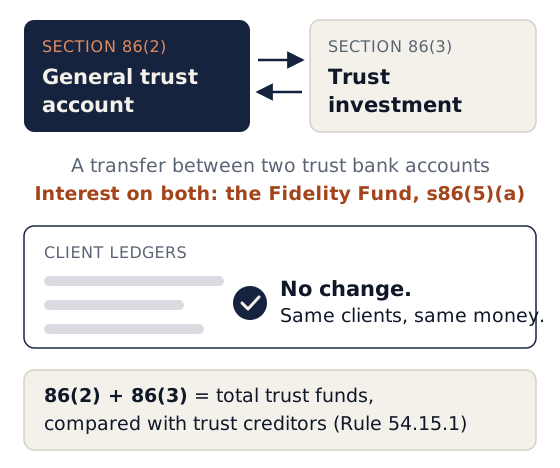
Why would a firm bother? Historically, to manage liquidity and bank charges. In practice, the main things to get right are:
- Record the transfer as a movement between two trust bank accounts. No client ledger changes: the money still belongs to the same clients.
- Include the 86(3) balance when you compare total trust funds with the list of trust creditors (Rule 54.15.1 refers to the "trust investment account").
- Do not let the 86(3) investment make the general account too thin to meet payments. If a client is owed money and the cash is locked in a notice deposit, you have a practical problem, not only an accounting one.
Rule 55 (investment practice rules) does not apply to section 86(3) investments (Rule 55.3.1).
Section 86(4): investing for a client
This is the one with the most rules attached.
When it is used
A firm may, on the instructions of any person, open a separate trust savings or other interest-bearing account to invest that person's money held in trust (s86(4)). Typical cases:
The requirements
| Requirement | Source |
|---|---|
| Invest only on the person's instructions | s86(4) |
| Invest only in a trust savings or other interest-bearing account with a bank | Rule 54.17.1 |
| Get the person's written confirmation of the investment as soon as reasonably possible, or notify them in writing immediately | Rule 54.17.2 |
| Have the account endorsed as opened in terms of section 86(4) | Rule 54.17.3 |
| Disclose in writing any commission, fee or reward from the bank before accepting it | Rule 54.18 |
| Deposit any withdrawal from the investment promptly back into the trust banking account (unless paying a guarantee issued on the strength of the investment) | Rule 54.14.7.3 |
| Keep records of all money invested under s86(4) and interest credited | Rule 54.6.3.2 to 54.6.3.4 |
| Bank at an institution with an arrangement with the Fund | s86(6) |
The 5% to the Fund
Interest on a section 86(4) investment is paid to the client, "provided that 5% of the interest accrued" is paid over to the Fund and vests in it (s86(5)(b)). Under the amended Rule 54.14.16.3, the bank pays the Fund's 5% through the Automated Monthly Transfer System within five working days of the month following the month in which it vested, or on maturity.
Tell clients this in writing when you take the mandate. A client who expects the full interest rate and receives 95% of the interest will phone you, not the Fund.
When Rule 55 also applies
If the firm invests money for clients and "controls or manages such investments" as a business, it is an investment practice under Rule 55, with extra mandate, reporting and record-keeping rules. Rule 55.3.2 excludes investments of a temporary nature made in the course of, and incidental to, a conveyancing or other matter such as litigation. Most 86(4) investments at small firms fall under that exclusion. If yours do not, read Rule 55 in full and speak to your auditor, because the auditor must state in the annual report whether the firm carried on an investment practice (Rule 54.24.3).
Recording a section 86(4) investment
Here is the life cycle of a R500,000 deposit held for a property purchaser, invested at 7% for 60 days pending registration.
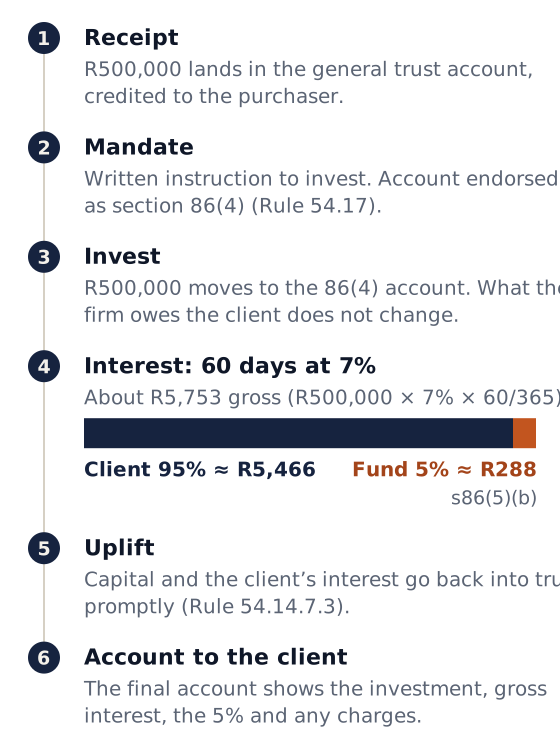
- Receipt. R500,000 is deposited into the general trust account and credited to the purchaser's trust ledger.
- Mandate. The purchaser signs an instruction to invest. You open an account endorsed "section 86(4)" and write to confirm (Rule 54.17).
- Investment. R500,000 moves from the trust bank account to the 86(4) account. In the client's records, the money moves from "trust held" to "trust invested". The total owed to the client does not change.
- Interest. Over 60 days the investment earns about R5,753 (R500,000 × 7% × 60/365). The client's share is 95%, about R5,466. The Fund's 5%, about R288, is swept to the Fund by the bank.
- Uplift. On registration the investment is uplifted. The capital plus the client's interest comes back into the general trust account promptly (Rule 54.14.7.3) and is credited to the client's trust ledger, ready for payment on the seller's side of the transaction.
- Accounting to the client. Your final account to the client (Rule 54.12) should show the investment, the gross interest, the 5% to the Fund and any bank charges.
Rule 54.28 also requires the firm to report the gross interest earned and gross charges levied on 86(2), 86(3) and 86(4) accounts in the relevant section of the annual audit report, even if no claim for bank charges is made. That is much easier if each investment has its own record from day one.
Mistakes auditors find
- No written instruction. An 86(4) account opened because "the client would obviously want interest". Without instructions it is not an 86(4) investment, and the interest position is unclear.
- Account not endorsed. The bank account is a normal savings account in the firm's name without the section 86(4) endorsement.
- Client ledger does not show the investment. The trust creditors list shows the client at R0 while R500,000 sits in an investment. The list must still account for it.
- The 5% forgotten. The client is credited with 100% of the interest.
- Uplift not banked back into trust. Capital paid straight from the investment to a third party without passing through the trust account, outside the guarantee exception in Rule 54.14.7.3.
- 86(3) and 86(4) mixed. Firm-initiated investments recorded against individual clients, or client investments pooled into the firm's 86(3) account.
- Unclaimed interest left in trust. Interest for a client who cannot be traced sits in trust indefinitely. Section 87(4) requires unclaimed money to be paid to the Fund after the second annual closing following the deposit.
Checklist for every new section 86(4) investment
- Written instruction from the client, filed on the matter.
- Letter to the client explaining the rate, term, bank, the 5% to the Fund and any charges.
- Bank on the Fund's list of banks with a section 63(1)(g) arrangement.
- Account endorsed as a section 86(4) account.
- Written confirmation from the client received, or written notice sent.
- Investment recorded against the client, separately from the general trust ledger balance.
- Diary entry for the maturity date.
- On uplift: capital and interest deposited back into trust, client ledger updated, investment account closed.
- Final account to client shows the investment and interest.
Where Caseo fits
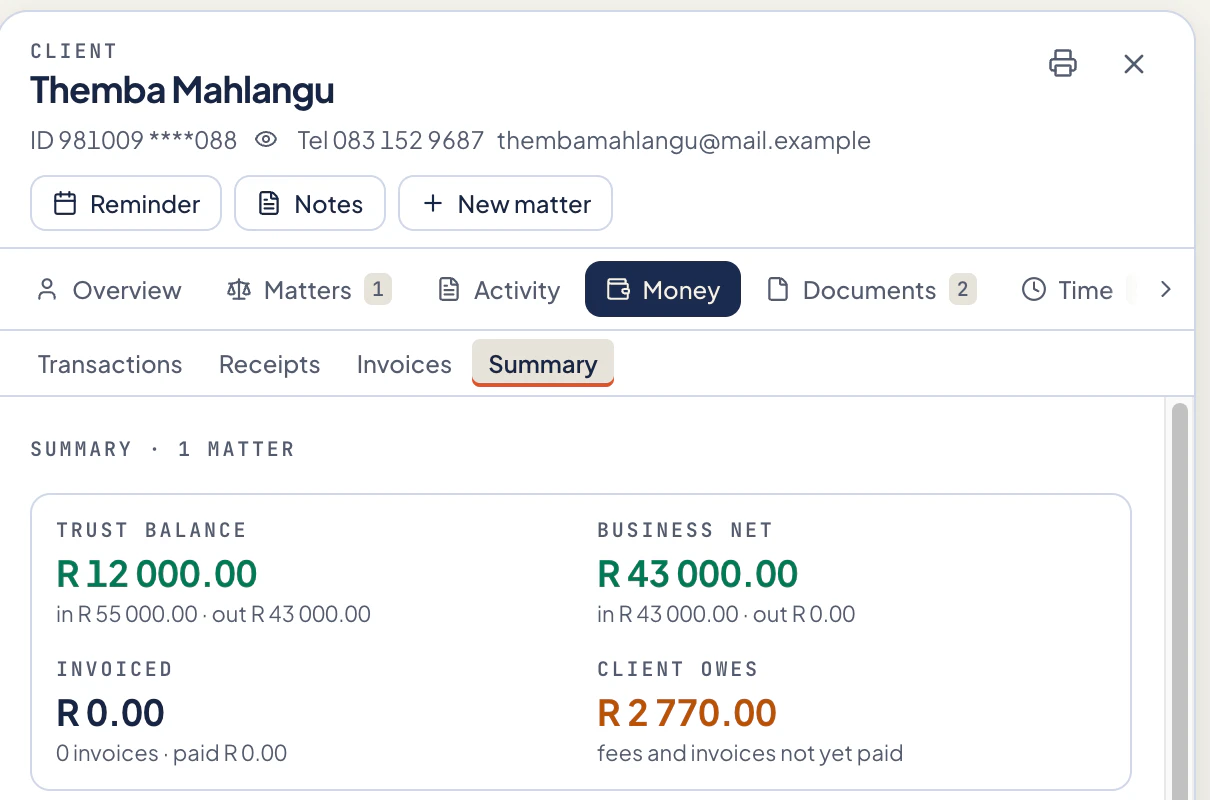
Caseo keeps trust and business in separate ledgers against every matter, shows each client's running trust balance, and lets you diarise maturity and follow-up dates for the attorney carrying the matter.
 1
2
3
1
2
3
- Every client has a Money tab across all their matters.
- The trust balance: what the firm holds for this client, with money in and out.
- Business is kept apart and never netted against trust.
It does not have a section 86 investment module, so firms that hold many 86(4) investments should keep their investment register alongside it (and tell us, because it shapes what we build next). If you are reviewing how your firm handles trust money, the Rule 54 guide and the month-end reconciliation checklist are the next two reads. To see the ledgers on sample data, have us call you.