
Every December, some practitioners discover that their Fidelity Fund certificate for the new year cannot be issued, because the trust audit report for their firm is late or qualified. Without a certificate, section 84(2) of the Legal Practice Act says neither they nor their staff may receive or hold money belonging to anyone. That includes deposits on account of fees (s84(3)).
The certificate itself is an online form and a small payment. The hard part is the audit report, and the audit report is decided by how the trust books were kept for the previous twelve months. This guide covers both.
General information, not legal advice. Deadlines and contribution amounts are set by the LPC each year; check the current notice.
Who needs a Fidelity Fund certificate
Section 84(1) requires a certificate for every attorney, and every advocate referred to in section 34(2)(b), who practises:
- for their own account, alone or in partnership; or
- as a director of a practice that is a juristic entity.
Practitioners in full-time employment of the State (as state attorneys or state advocates), the South African Human Rights Commission, and Legal Aid South Africa (on a permanent basis) are excluded (s84(1) and 84(7)). Employed attorneys at a private firm do not need their own certificate, but they may only handle trust money because the principals hold certificates.
Needs a certificate
- Attorneys practising for their own account, alone or in partnership
- Directors of a practice that is a juristic entity
- Advocates referred to in section 34(2)(b)
Does not need their own
- Employed attorneys at a private firm, who handle trust money under the principals’ certificates
- Practitioners in full-time employment of the State, as state attorneys or state advocates
- Practitioners in full-time employment of the South African Human Rights Commission
- Practitioners employed by Legal Aid South Africa on a permanent basis
A certificate is valid until 31 December of the year for which it was issued (s85(7)). You apply every year.
What the LPC requires
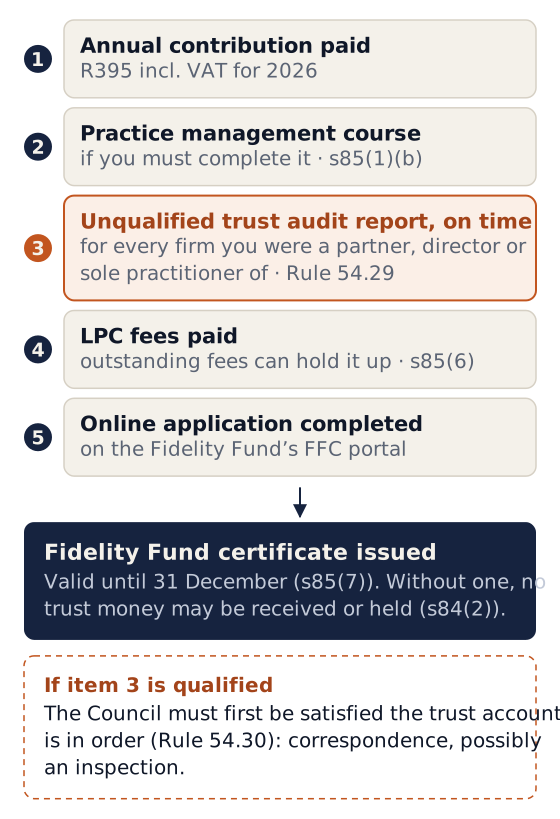
For the 2026 certificates, the LPC's notice of 7 November 2025 (published via De Rebus) listed four requirements:
- Payment of the annual contribution. R395, VAT included, for 2026.
- Proof of completion of the Legal Practice Management course, for practitioners who must complete it (s85(1)(b) and Rule 47.7.1).
- Compliance with the Act, including the timeous submission of an unqualified trust account audit report (s84(6) and Rule 54.29).
- The completed online application on the Fidelity Fund's FFC portal at ffc.fidfund.co.za.
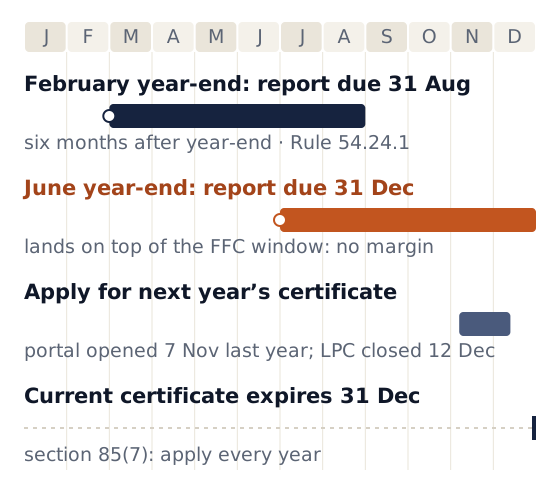
The same notice said LPC offices would close from 12 December 2025 to 5 January 2026 with reduced staff, and urged practitioners to finish before 12 December. Expect a similar window this year. If the 2027 portal follows the same pattern, it will open in early November 2026.
Section 85(6) adds that the Council issues the certificate once it is satisfied the applicant has complied with the Chapter, paid the contribution, paid all enrolment fees and completed the form in every respect. Outstanding LPC fees can hold up a certificate as easily as an audit report.
The audit report is the real requirement
Rule 54.29
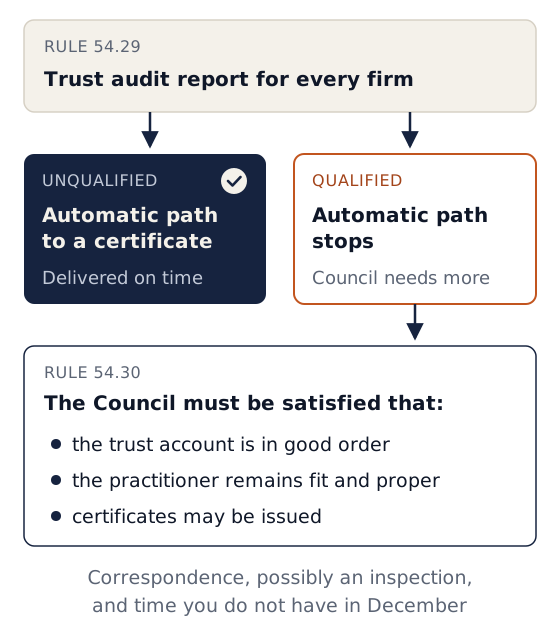
To qualify for a Fidelity Fund certificate, a trust account practitioner must ensure that an unqualified audit or inspector's report is issued for every firm of which they are or were a partner, director or sole practitioner during the period under review, and delivered on time.
LPC Rule 54.29 (paraphrased)In practice: note "every firm" and "were". If you left a partnership mid-year, that firm's report affects your certificate too.
When the report is due
| Situation | Deadline | Rule |
|---|---|---|
| Established firm | Within six months of the annual closing of the firm's accounting records | 54.24.1 |
| New firm | A report covering the first four months of practice, within six months of starting | 54.21 |
| Firm closing | An audit report up to closure of the trust account, within three months of ceasing to practise | 54.32.1 |
A firm with a February year-end must deliver its report by 31 August. A firm with a June year-end has until 31 December, which leaves no margin at all for FFC issue in January. If your year-end is late in the year, ask your auditor to start early.
The report must be in the format the LPC prescribes (Rule 54.23 and 54.24.1). The LPC can condone a late report on written application (Rule 54.23), but condonation is discretionary. Do not plan around it.
If the report is qualified
A qualified report does not automatically end your practice, but it stops the automatic path to a certificate. Rule 54.30 requires the firm to give the Council whatever information it needs to be satisfied that the trust account is in good order, that the practitioner remains fit and proper, and that certificates may be issued. That means correspondence, possibly an inspection, and time you do not have in December.
What gets reports qualified
These are the findings that turn up most often. Almost all of them are visible month by month, long before the auditor arrives.
| Finding | Rule | How to prevent it |
|---|---|---|
| Trust funds less than total trust creditors (a deficit) at any date | 54.14.8, 54.14.10 | Monthly reconciliation; report immediately if it happens |
| A trust creditor in debit | 54.14.9, 54.14.11 | Software that blocks or warns on overdrawing a client ledger |
| Records not written up within a month of month-end | 54.10 | A fixed monthly close date |
| Monthly list of trust creditors missing or not compared | 54.15 | System-generated list every month, signed |
| Trust-to-business transfers not tied to fees debited to a specific client | 54.11, 54.14.14 | Raise the fee on the matter, then transfer that exact amount |
| Receipts not banked intact by the next banking day | 54.14.7.2 | Daily banking routine; no netting |
| Section 86(4) investments without written instructions or endorsement | 54.17 | Checklist per investment (see our section 86 guide) |
| Payee bank details not verified | 54.13, 54.14.5 | Call-back verification on a known number |
| Internal controls not designed, not operating, or not monitored | 54.14.7.1 | Documented review and sign-off each month |
| Records or backups not kept | 54.9, 54.14.3 | Monthly off-site backup; know how to export |
Your auditor also has a direct duty to report to the Council, without waiting for the annual report, if trust balances exceed trust funds, if material queries are not answered to their satisfaction, or if access to records is refused (Rule 54.24.2). Answer audit queries quickly and in writing.
A year-round checklist
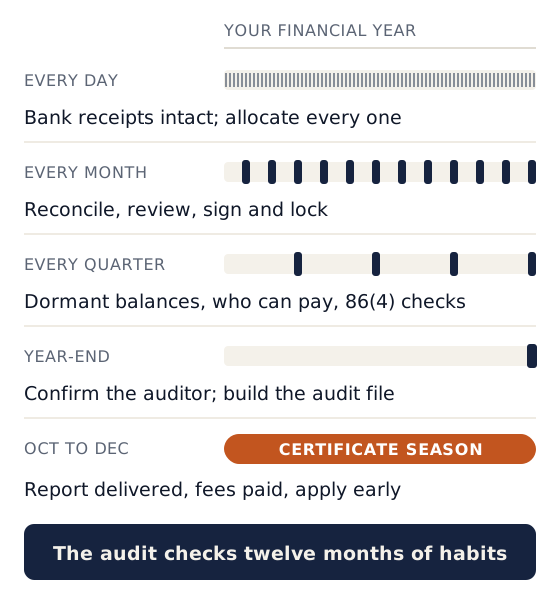
The audit is only a point-in-time check on twelve months of habits. This is the rhythm we recommend, built on LPC Rule 54.
Every day
- Bank all trust receipts intact, by the next banking day.
- Allocate every receipt to a named client and matter.
- Two people involved in every trust payment (capture and release).
Every month (by the 10th working day)
- Reconcile trust bank to cash book; compare cash book and investments to the list of trust creditors.
- Check for debit balances and unallocated money.
- Transfer fees due from trust to business, per client, against fees already debited.
- Partner or director reviews and signs the reconciliation.
- Lock the month.
- Back up the records off-site.
Every quarter
- Review trust balances with no movement in 12 months and contact the clients. Section 87(4) money (unknown owner or unclaimed after a year) must go to the Fund after the second annual closing following the deposit.
- Review who can release trust payments and change bank details. Remove people who have left.
- Check every section 86(4) investment against its mandate and maturity date.
At year-end
- Confirm the audit appointment and fee with your auditor (Rule 54.20 requires an appointment at least once a calendar year).
- Prepare the audit file: twelve signed reconciliations, twelve lists of trust creditors, bank and investment statements, the 86(4) register with mandates, and the trust interest and bank charges figures (Rule 54.28).
- Diarise the six-month deadline for the report and a date two months earlier to chase it.
October to December
- Confirm with your auditor that the report has been delivered to the LPC, and ask for proof.
- Pay outstanding LPC fees.
- Check practice management course status for any practitioner in their first year.
- Apply on the FFC portal as soon as it opens; aim to finish before the LPC's December closure.
- Once issued, check each certificate on the LPC's FFC verification page. Banks, conveyancers and clients use the same page to check yours.
When things change mid-year
- Moving firms or ceasing to practise. Section 84(5) requires you to notify the Council and comply with its requirements for closing your trust account; if you stop practising, you must return the certificate.
- Closing a firm. Rule 54.31 requires written notice to the Council before you stop, including your latest trust reconciliation, your bookkeeper's details and the auditor who will do the final audit. Rule 54.32 then requires, within three months, the final audit report, a final list of trust creditors, auditor confirmation that all trust creditors were paid (or a signed transfer of trust creditors to another firm), and a nil-balance certificate from the bank.
- Opening a new firm. Remember the four-month report under Rule 54.21. New principals are often surprised by it.
How software makes the audit shorter
Auditors spend most of their time rebuilding evidence that should already exist: whether each month was reconciled and reviewed, whether the list of trust creditors came from the ledger, whether a closed month was edited later, and whether every transfer to business had a fee behind it. When the system produces that evidence as a by-product of normal work, the audit becomes a review rather than an investigation.
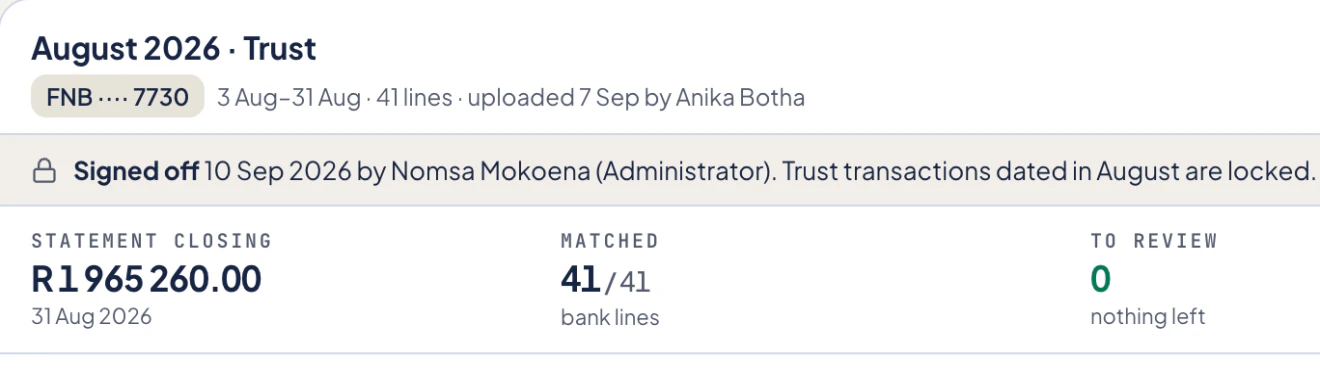
Caseo is built around LPC Rule 54: trust and business are separate ledgers against each matter, the trust balances per client report is checked against the trust ledger, and a reconciled month is signed off and locked. Month-end packs and client statements come from the same data your auditor will look at.
 1
2
3
1
2
3
- Sign-off records who signed, their role and when, then locks that month’s trust transactions.
- The bank statement is imported and matched to the trust ledger line by line.
- Sign-off stays blocked while anything is left to review, and for trust until the difference is R0.00.
If this year's audit was harder than it should have been, have us call you before next year-end and we will show you on sample data.