
A trust reconciliation proves one thing: that the money in your trust bank account (and trust investments) is at least equal to what you owe every client whose money you hold. Everything else in the month-end routine exists to produce that proof and catch problems while they are small.
This is the checklist we would give a new bookkeeper at a South African firm. It follows the requirements of LPC Rule 54, in particular Rule 54.10 (monthly write-up), Rule 54.14.8 and 54.14.9 (no deficit, no debit balances) and Rule 54.15 (the monthly list of trust creditors).
General information only, not accounting or legal advice. Your auditor sets the standard your firm's reconciliation will be tested against.
The three numbers
A trust reconciliation ties together three independent figures. When people say "three-way reconciliation", this is what they mean.
| Number | Where it comes from | What it tells you |
|---|---|---|
| A. Bank balance | The trust bank statement at month-end | What the bank says you hold |
| B. Cash book balance | Your trust bank ledger (every receipt and payment you recorded) | What your books say you hold |
| C. Trust creditors total | The sum of every client's trust ledger balance (the list required by Rule 54.15) | What you owe clients |
The reconciliation has two halves:
- A reconciles to B. The bank balance, adjusted for timing differences, equals the cash book. This proves your books record what actually happened at the bank.
- B (plus trust investments and trust cash) equals C. This proves every rand in trust is allocated to a named client, and is the comparison Rule 54.15.1 requires.
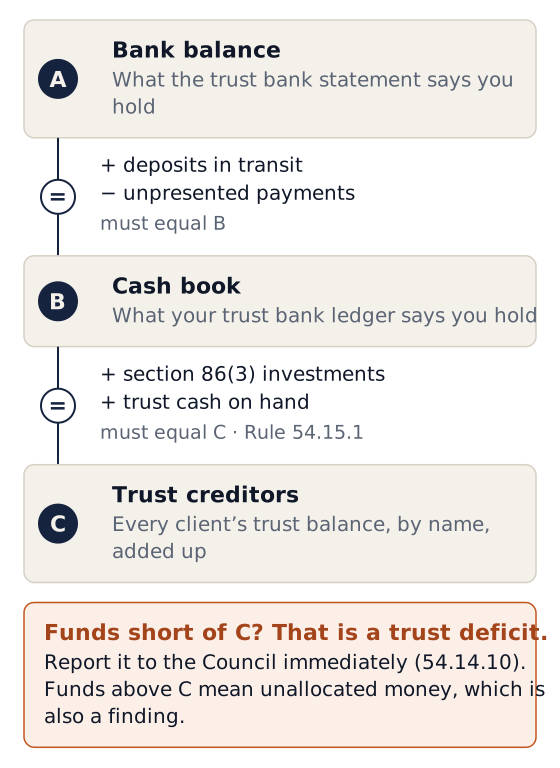
If B plus investments is less than C, you have a trust deficit, and Rule 54.14.10 requires you to report it to the Council immediately in writing. If it is more than C, you have unallocated money in trust, which is also a finding: either business money that should have been transferred out (Rule 54.11), or client money nobody has allocated.
Deadline
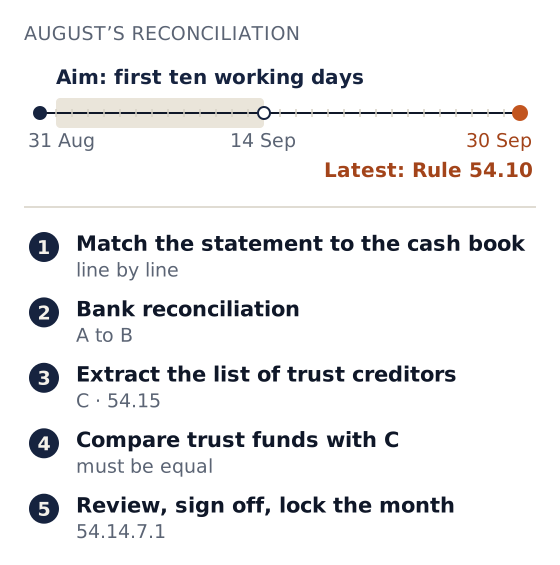
Rule 54.10: a firm must update and balance its records monthly, and is deemed to comply if the month is written up by the last day of the following month. For August, that is 30 September. Aim for the first ten working days. A difference found on the 5th is usually a posting error; one found at year-end is an audit qualification.
Month-end checklist
Before you start
- All receipts for the month are captured and allocated to a matter. Unallocated receipts go into a suspense ledger only temporarily and are listed separately.
- All payments are captured, each against a matter and a named payee.
- Fee and disbursement transfers from trust to business for the month are done, each identifiable with a specific client and not more than is due (Rule 54.11.2).
- Bank charges and interest lines from the statement are captured.
- You have the trust bank statement for the full month, plus the statements for every section 86(3) and 86(4) investment account.
Step 1: Match the bank statement to the cash book
Go line by line. Every statement line should match a cash book entry by amount and date (or a date a day or two apart). Tick both sides.
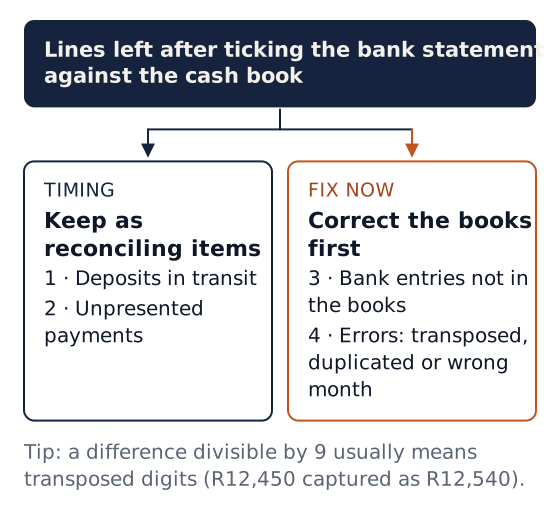
What's left after matching falls into four groups:
- Deposits in transit. Money you receipted in the books on the last day that the bank only shows next month.
- Unpresented payments. Payments you recorded that have not yet gone off the bank account (an EFT captured but released on the 1st, or an old cheque).
- Bank entries not in the books. Direct deposits from clients you did not know about, bank charges, interest, reversals. These need capturing now, against the right matter.
- Errors. Transposed figures (R12,450 captured as R12,540), duplicates, entries in the wrong month.
Groups 1 and 2 are timing differences and are legitimate reconciling items. Groups 3 and 4 must be fixed in the books before you go further.
Step 2: Prepare the bank reconciliation (A to B)
Once groups 3 and 4 are fixed:
Balance per bank statement
+ deposits in transit
- unpresented payments
= Balance per cash book
If it does not balance, the difference is almost always one of: a missed line, a transposition (a difference divisible by 9 is a strong hint), a duplicated entry, or a payment captured against the business account that went off trust (or the reverse, which is far more serious).
Step 3: Extract the list of trust creditors (C)
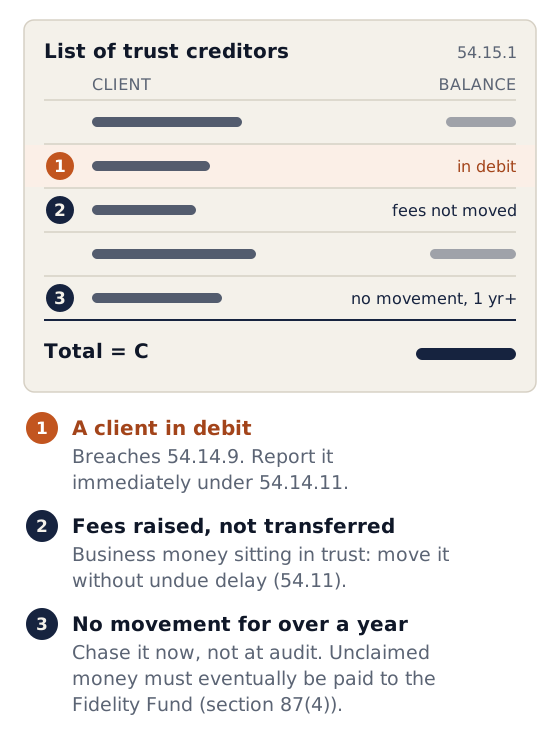
Rule 54.15.1 requires a legible list of every person for whom money is held, identified by name, with the balance for each. Total it.
While you extract it, scan for three things:
- Debit balances. Any client ledger below zero breaches Rule 54.14.9 and must be reported immediately under Rule 54.14.11, with an explanation and proof of rectification.
- Business money sitting in trust. A client whose fees have been raised but not transferred. Transfer it (Rule 54.11 wants it moved "without undue delay").
- Stale balances. Money held for over a year with no movement. Section 87(4) of the Legal Practice Act requires money whose owner is unknown, or that is unclaimed after one year, to be paid to the Fidelity Fund after the second annual closing of the books following the deposit. Chase these now, not at audit.
Rule 54.15.2 also requires each extracted balance to be noted in the ledger account it came from. Most software does this by storing the month-end balance per client.
Step 4: Compare B with C
Balance per cash book (trust bank)
+ section 86(3) trust investments
+ trust cash on hand (if any)
= Total trust funds

Total trust funds  vs  Total of list of trust creditors
They should be equal. If total trust funds are lower, stop and escalate: that is a reportable deficit under Rule 54.14.10.
Section 86(4) investments (client-mandated investments where the interest goes to the client) are reconciled per investment: the bank's investment statement against the client's investment ledger. Many firms present them as a separate section of the trust creditors list. Agree the presentation with your auditor and keep it consistent.
Step 5: Review, sign off, lock
- Someone other than the preparer reviews it. Rule 54.14.7.1 requires internal controls monitored "by designated persons in the firm having the appropriate authority". A partner or director signature on each month's reconciliation is the simplest evidence.
- The signed reconciliation, the list of trust creditors and the bank statements are filed together. They form part of the accounting records you must keep for at least seven years (Rule 54.9.1).
- The month is locked so nobody can post into it afterwards. Backdated entries into a reconciled month are one of the first things an auditor looks for.
- A monthly backup of the records is kept off-site (Rule 54.14.3), if your system does not already do this for you.
…by designated persons in the firm having the appropriate authority.
LPC Rule 54.14.7.1In practice: the person who prepares the reconciliation is not the person who signs it. A partner or director signature on each month's reconciliation is the simplest evidence that the control is being monitored.
Worked example: August 2026
A small firm's trust position at 31 August 2026.
Bank to cash book
| Amount (R) | |
|---|---|
| Balance per trust bank statement, 31 Aug | 1,284,650.00 |
| Add: deposit in transit (client EFT receipted 31 Aug, cleared 1 Sep) | 25,000.00 |
| Less: unpresented payment (payment to counsel captured 31 Aug, released 1 Sep) | (42,300.00) |
| Balance per cash book | 1,267,350.00 |
Trust funds to trust creditors
| Amount (R) | |
|---|---|
| Cash book (trust bank) | 1,267,350.00 |
| Section 86(3) investment | 300,000.00 |
| Total trust funds | 1,567,350.00 |
| Total per list of trust creditors (46 clients) | 1,567,350.00 |
| Difference | 0.00 |
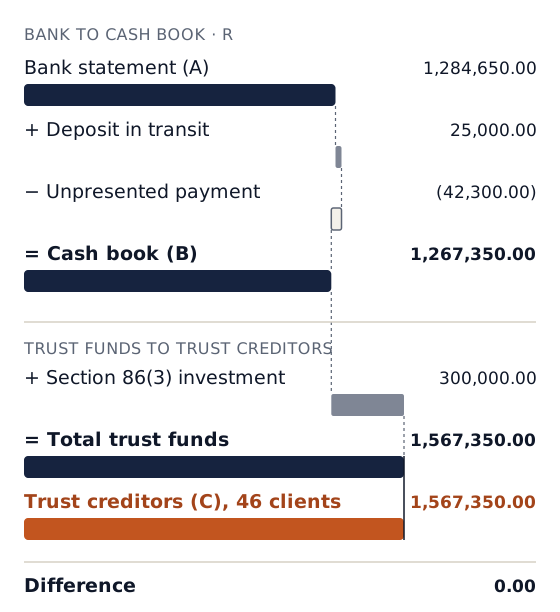
The list shows no debit balances. Two clients have fees raised but not transferred (R8,400 in total), which are transferred on 2 September against those two matters. The reconciliation is signed by the director on 4 September and August is locked.
Suppose instead the list had totalled R1,569,850.00. Trust funds would be R2,500 short. The most common causes, in order:
- A receipt on a client ledger but not in the cash bookA one-sided entry. Find it and complete it. Posting fix
- A payment in the cash book against the wrong clientCorrect the posting to the right client ledger. Posting fix
- A genuine overpayment from trustA trust creditor is in debit, and that must be reported. Rule 54.14.11
Common differences and where to look
| Symptom | Usual cause | Fix |
|---|---|---|
| Bank higher than cash book by an odd amount | Direct deposit not captured | Identify the depositor, receipt it to the matter |
| Cash book higher than bank | Payment captured in books, not yet released or rejected by bank | Confirm with bank; if rejected, reverse and re-pay |
| Difference divisible by 9 | Transposed digits | Compare statement and ledger amounts line by line |
| Trust creditors higher than cash book | Receipt posted to client ledger but not cash book, or payment posted to cash book only | Find the one-sided entry |
| A client in debit | Paid out against uncleared funds, or posted to the wrong matter | If a mis-post, correct; if real, fund it and report under Rule 54.14.11 |
| Same difference two months running | Reconciling item never cleared (e.g. a stale unpresented cheque) | Investigate and write back or re-issue |
How long should it take?
For a firm with a few hundred trust transactions a month, a clean reconciliation with software that imports the bank statement and suggests matches should take under an hour. If it takes a day, the cause is usually upstream:
Fix the daily habits and the month-end shrinks.
Frequently asked questions
Do I have to reconcile monthly, or is that best practice? Monthly. Rule 54.10 requires the records to be updated and balanced monthly, and Rule 54.15 requires the list of trust creditors to be extracted and compared monthly.
Who must sign the reconciliation? The rules do not name a person, but Rule 54.19 makes every partner and director responsible for trust compliance, and Rule 54.14.7.1 requires controls monitored by people with appropriate authority. A partner or director review and signature is the defensible minimum.
Is a spreadsheet reconciliation acceptable? Nothing in Rule 54 prohibits it, but it is hard to show that the list of trust creditors was extracted from the ledger rather than typed in, or that a reconciled month was not changed later. That is why auditors prefer system-generated lists and locked periods.
What if the difference is tiny? A R3.50 difference still means something is wrong. Find it. Small differences often hide two larger errors that nearly cancel out.
Doing this in Caseo
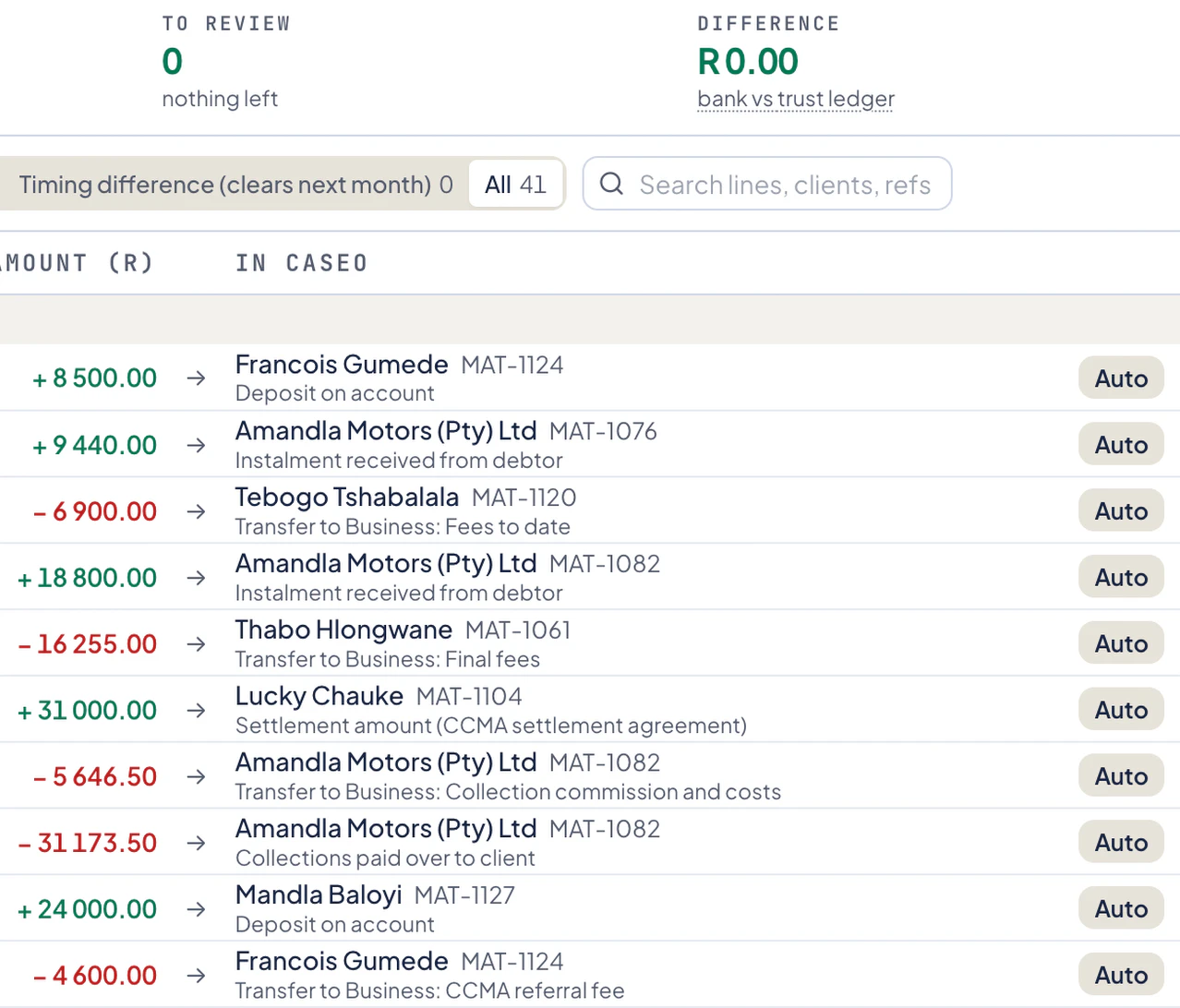
In Caseo you import the trust bank statement (OFX, or CSV from FNB, Standard Bank, Nedbank, Capitec, ABSA or any bank with a saved column mapping) and each line is paired with the trust ledger by amount, date and reference. Deposits in transit and uncleared payments carry forward to the next month.
 1
2
3
1
2
3
- Each statement line is paired with a trust ledger entry for a named client and matter. Auto means the match was made by amount, date and reference.
- A deposit in transit is carried to next month rather than forced to match.
- The difference between bank and trust ledger must be R0.00 before the month can be signed off.
The three-way check compares the adjusted bank balance, the trust ledger and the client balances, with each check labelled by its Rule 54 reference: agreement (54.14.8), no matter in debit (54.14.9), every fee transfer paired (54.11) and the due date (54.10). Sign-off is only possible once the difference is R0.00 with no matter in debit; Caseo records who signed and when, keeps a snapshot, and locks the month. There is more detail in how reconciliation works in Caseo.
If your month-end currently lives in a spreadsheet, have us call you and we will walk through last month's reconciliation with you.